

Introduction to Decimals and Fractions
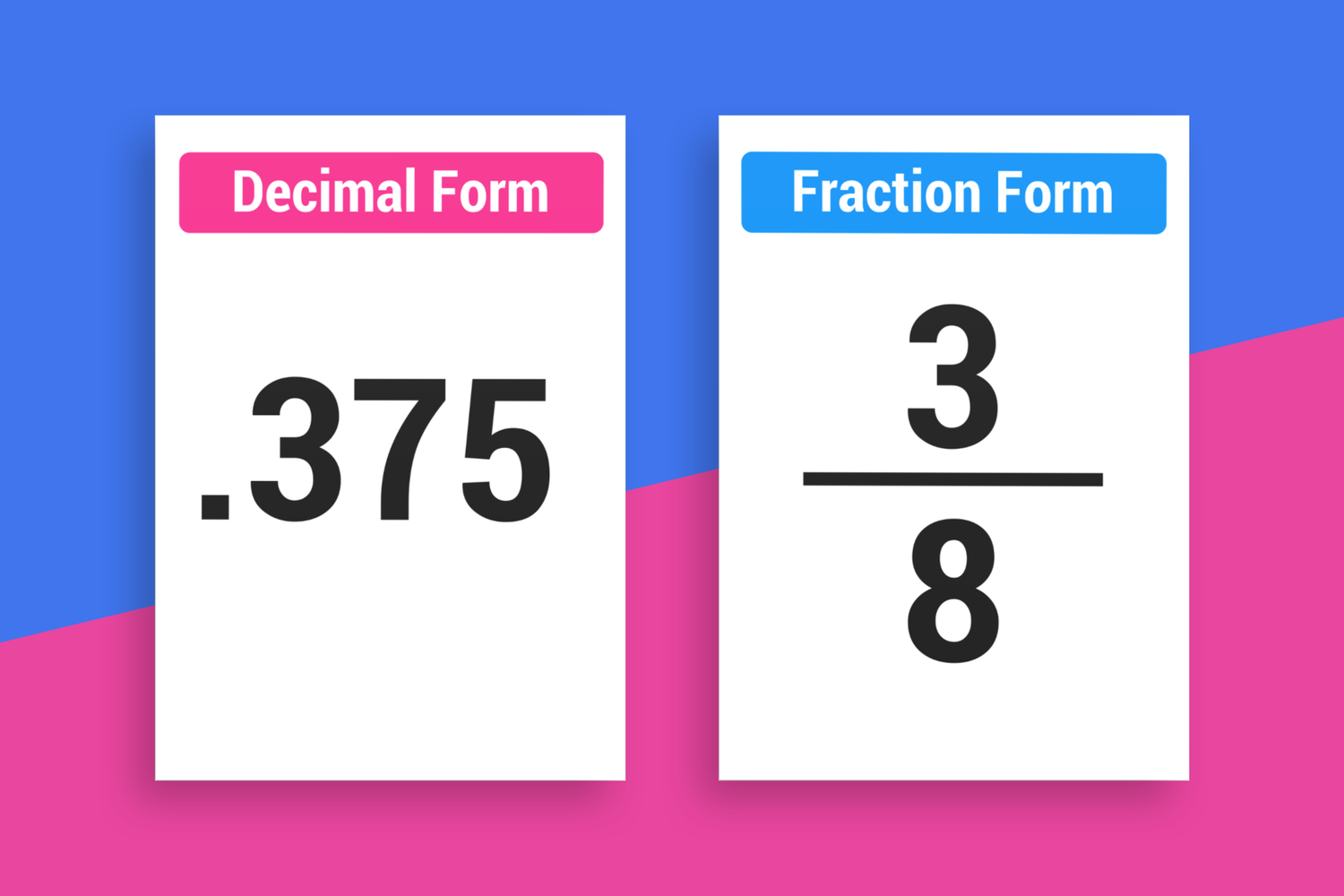
Decimals and fractions are two fundamental ways of representing numbers in mathematics, each serving distinct purposes and showcasing different attributes of numerical values. A decimal is a base-ten representation that utilizes a decimal point to separate the whole number part from the fractional part. For instance, the decimal number 0.375 illustrates a value that is three hundred seventy-five thousandths. This demonstrates how decimals enable precise measurement and representation of quantities.
Conversely, a fraction, such as .375 expressed as a fraction is written as 375/1000, represents a part of a whole divided into equal segments. In this case, the numerator (375) signifies the number of segments selected, while the denominator (1000) indicates the total number of same-sized segments that comprise the whole. Understanding both decimals and fractions is critical in mathematical literacy, as it allows individuals to manipulate and convert between these two forms as needed.
Furthermore, both decimals and fractions are essential in many real-life applications, from financial calculations to measurements in science and engineering. For example, when performing operations such as addition, subtraction, multiplication, or division, one may need to convert between .375 as a fraction and its decimal form to achieve the desired result, ensuring accuracy and precision in calculations. Familiarity with these concepts not only enhances problem-solving skills but also builds a foundation for more advanced mathematical topics.
Converting the decimal .375 to a fraction involves a straightforward process that can be broken down into a series of clear steps. The first step is to identify the place value of the decimal. In the case of .375, the digit 3 is in the tenths place, 7 is in the hundredths place, and 5 is in the thousandths place. Therefore, .375 can be expressed as 375 over 1000, resulting in the fraction:
[ frac{375}{1000} ]
The next step in the conversion is to simplify this fraction to its lowest terms. To accomplish this, we need to find the greatest common divisor (GCD) of the numerator (375) and the denominator (1000). Upon determining the factors, it is found that the GCD is 125.
Now, we will divide both the numerator and denominator by 125:
[ frac{375 div 125}{1000 div 125} = frac{3}{8} ]
This means that .375 can be accurately expressed as the fraction 3/8. To confirm the accuracy of this conversion, it can be helpful to convert the fraction back to a decimal. Performing the division of 3 by 8 yields 0.375, which verifies the simplification process. Thus, the decimal .375 as a fraction is 3/8.
For our practical example, consider converting another decimal, such as .625. Following the same procedure, it can be expressed as 625 over 1000. Simplifying this involves dividing both the numerator and denominator by their GCD, which is 125, resulting in the fraction 5/8. By practicing these steps, converting decimals to fractions becomes increasingly intuitive.
Visual Representation of .375 as a Fraction
The decimal .375 can be expressed as a fraction, specifically 3/8, which effectively allows for various visual representations to enhance understanding. Visual aids such as pie charts, bar graphs, and number lines play an essential role in solidifying the concept of .375 as a fraction.
To represent .375 using a pie chart, one can visualize a whole pie divided into 8 equal slices. Since .375 corresponds to 3 out of these 8 slices, shading in 3 of the slices clearly illustrates the fraction’s value. This visual approach not only emphasizes the fraction 3/8 but also provides an intuitive grasp of how parts of a whole relate to their decimal representations.
Bar graphs offer another effective method of visualizing .375. A bar can be divided into 8 equal segments, where .375 (or 3/8) would occupy three segments, allowing viewers to see at a glance how much of the whole is represented by the fraction. This comparison not only aids in the understanding of the value of .375 but also reinforces the concept of fractions increasing or decreasing in proportion to the total.
Additionally, representing .375 on a number line illustrates its position relative to other decimals and fractions. By marking points for values such as 0, 0.5, and 1, one can plot .375 between 0.25 and 0.5. This position on the number line enhances comprehension of how .375 fits within the set of rational numbers, reinforcing its identity as 3/8.
Through these visual methods, the concept of .375 as a fraction is rendered more accessible and clear, allowing for a deeper understanding of fractional representation in both mathematical contexts and real-world applications.
Applications of .375 as a Fraction in Real Life
The understanding of .375 as a fraction—specifically, its equivalent representation as 3/8—has practical implications across various domains, including cooking, finance, and measurements.
In the culinary field, precise measurements are crucial for recipe accuracy. For instance, when a recipe calls for 0.375 cups of an ingredient, converting this decimal into its fractional form—3/8 cups—can simplify the measuring process, especially when using standard measuring cups. Many measuring tools in kitchens are marked in fractions, making it easier to follow the recipe and ensuring the right balance of flavors and textures. Thus, comprehending how to convert .375 into a fraction aids in achieving optimal cooking results.
In finance, understanding .375 as a fraction can play a significant role in calculations involving interest rates, percentages, and profit margins. For example, if an investment yields a return of 37.5%, one might express this in fraction form as .375, facilitating more straightforward calculations. Individuals might find it easier to compare different investment opportunities and analyze terms such as mortgage rates or loan agreements when using fractions over decimals, leading to more informed financial decision-making.
Moreover, in measurements, particularly in fields such as construction and engineering, fractions are frequently employed. Understanding .375 as a fraction can assist professionals in providing accurate dimensions. For instance, when dimensions are presented in inches, noting that .375 equals 3/8 inches ensures precision in cutting and assembling materials. Conversion knowledge thus contributes greatly to maintaining high standards of accuracy and reducing errors.
In summary, recognizing and utilizing .375 as a fraction is not merely an academic exercise; it reflects a fundamental skill with practical applications in everyday tasks, trade, and professional practices.
